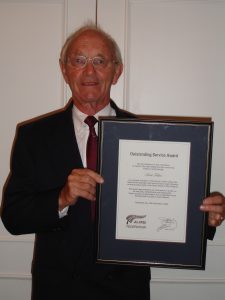
Presented in Auckland,24th November 2006
Henk Fekkes was born in the Netherlands in 1934 and grew up on the Dutch island of Terschelling. In 1953 he enrolled at the Centraal Instituut voor de Opleiding van Sportleiders (Central Institute for the Education of Sports Teachers - CIOS) in Overveen, Haarlem, and there began studies in judo and ju-jitsu, alongside other sports such as swimming and tennis. Henk’s early instructor was Jaap Nauwelaerts d’Agé (later 9th dan) and the style of ju-jitsu he taught was Kawaishi Nihon Goshin Jutsu, also known as Combat Ju-jitsu. In 1955 Henk gained his black belts in both judo and ju-jitsu and opened his own martial arts school in Leeuwarden, a city in northern Netherlands.
Towards the end of 1958, Henk decided to immigrate to New Zealand and sold his school. He arrived in New Zealand in 1959 and settled in Christchurch. Almost immediately, Henk became involved at the Crichton Cobbers Club, an iconic Christchurch sports club founded in 1926. There, he taught judo and ju-jitsu, and produced such notables as Frank Best, who later became the Australian Open judo champion, and Des Bryson. In 1960 Henk began work as a physical education teacher at Papanui High School in Christchurch and ten years later became the school’s head of physical education. About that time self defence began to be taught in the fourth and fifth form as part of the school’s Liberal Studies. Belts were not awarded in the traditional manner but certificates were issued on the completion of courses. These were particularly appreciated by boys wanting to join the police or army.
Outside of school, from 1962 Henk began teaching martial arts twice-weekly at the Christchurch YMCA. His preference was for ju-jitsu and a number of promising students emerged, including the likes of Paul Reti. However it was not until Henk’s grading to 3rd dan by Geshu Ichijyoan, 9th dan of the Japan Fuji Ryu Goshindo in 1972, that he was able to grade students to black belt. One such student was John Boniface, a strong influence on Christchurch martial arts who trained in Japan over eighteen years and who became highly graded in Fuji Ryu Goshindo, Seibukan Karate Jutsu, Kodokan Judo, Kendo, Kempo and Kobudo. Another was James Salter, who now heads Sakura Kan Jiu Jitsu, an off-shoot of Fuji Ryu.
However, Henk’s workload at Papanui High School, along with studies in accountancy at the Technical Institute, saw him take a less active role at the YMCA during the seventies. He still taught self defence at school and ran Ladies Keep Fit classes in the evenings, and he continued to teach ju-jitsu to those who wished to learn. From 1994 to 1997 Henk taught at the Cranford Street Gym and during that time Frank Best and Henk formulated a self defence programme that ran on the local television channel. In 1997, after 37 years service, Henk retired from Papanui High School.
More recently, Henk and Frank Best began their own martial arts school in 2002 where the emphasis is on judo and ju-jitsu and where they run special classes for the over-40s. In 2005 a bout of poor health caused the 71 year-old to pause in his training, but he retains an active interest in the club and in the ju-jitsu community. Henk Fekkes has made a lasting impression on ju-jitsu in New Zealand. His own career has spanned five decades and eight martial arts clubs can trace their teaching back to the ju-jitsu style that Henk introduced to New Zealand.
Written by: Doug Bailey, OSA - 2nd December 2006
Subsequent
Unfortunately Henk Fekkes passed away on 19th April 2012 in Christchurch, a sad loss to New Zealand Ju-Jitsu.